Proof, not just a pitch
Three examples of what happens when clinical triage and case management instincts get pointed at digital health problems.
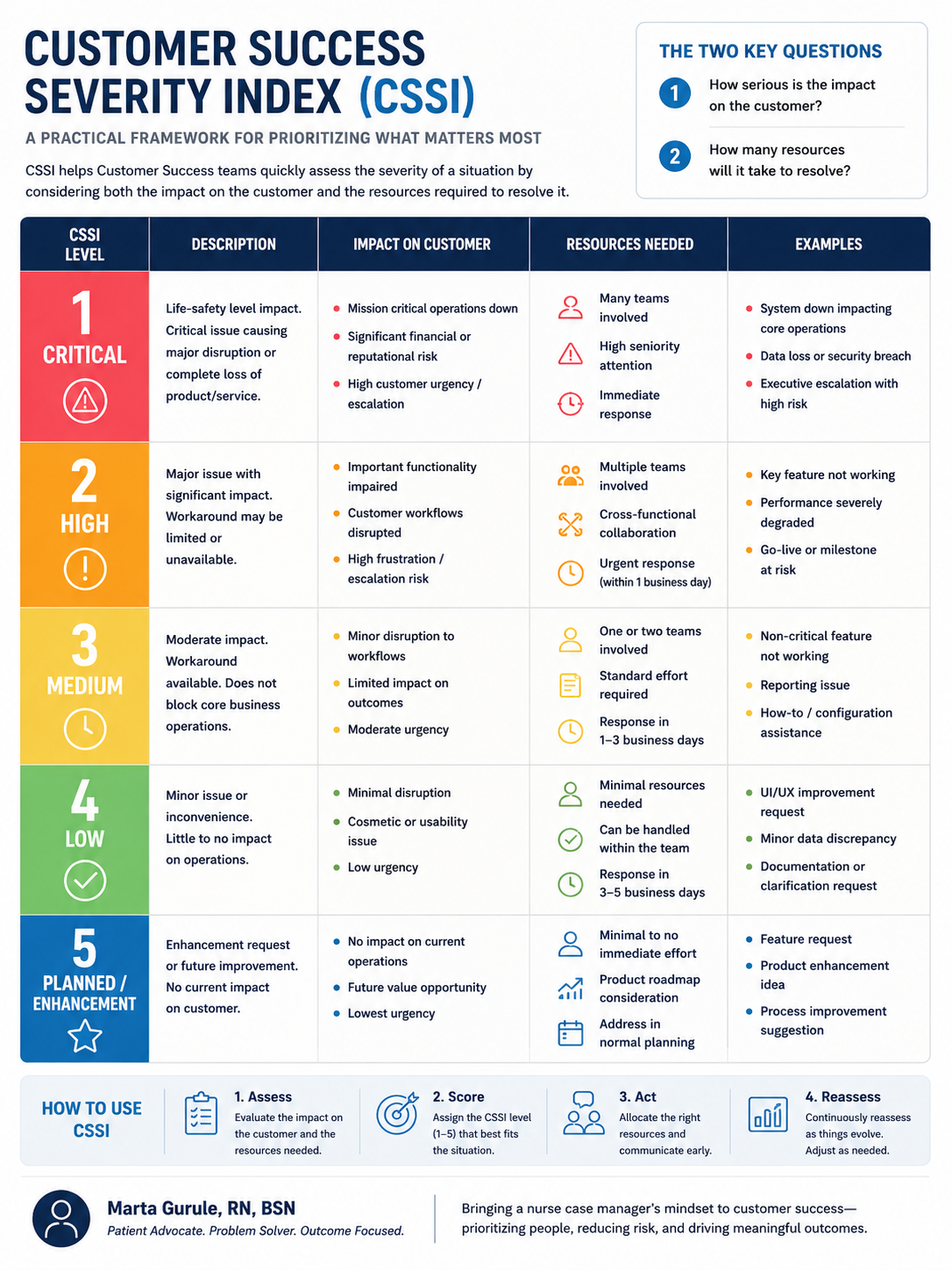
Building a Triage Framework for Customer Success
The ProblemCustomer success teams often lack a structured way to prioritize accounts under pressure, similar to how an Emergency Department without triage would just see whoever's loudest first, instead of whoever's sickest.
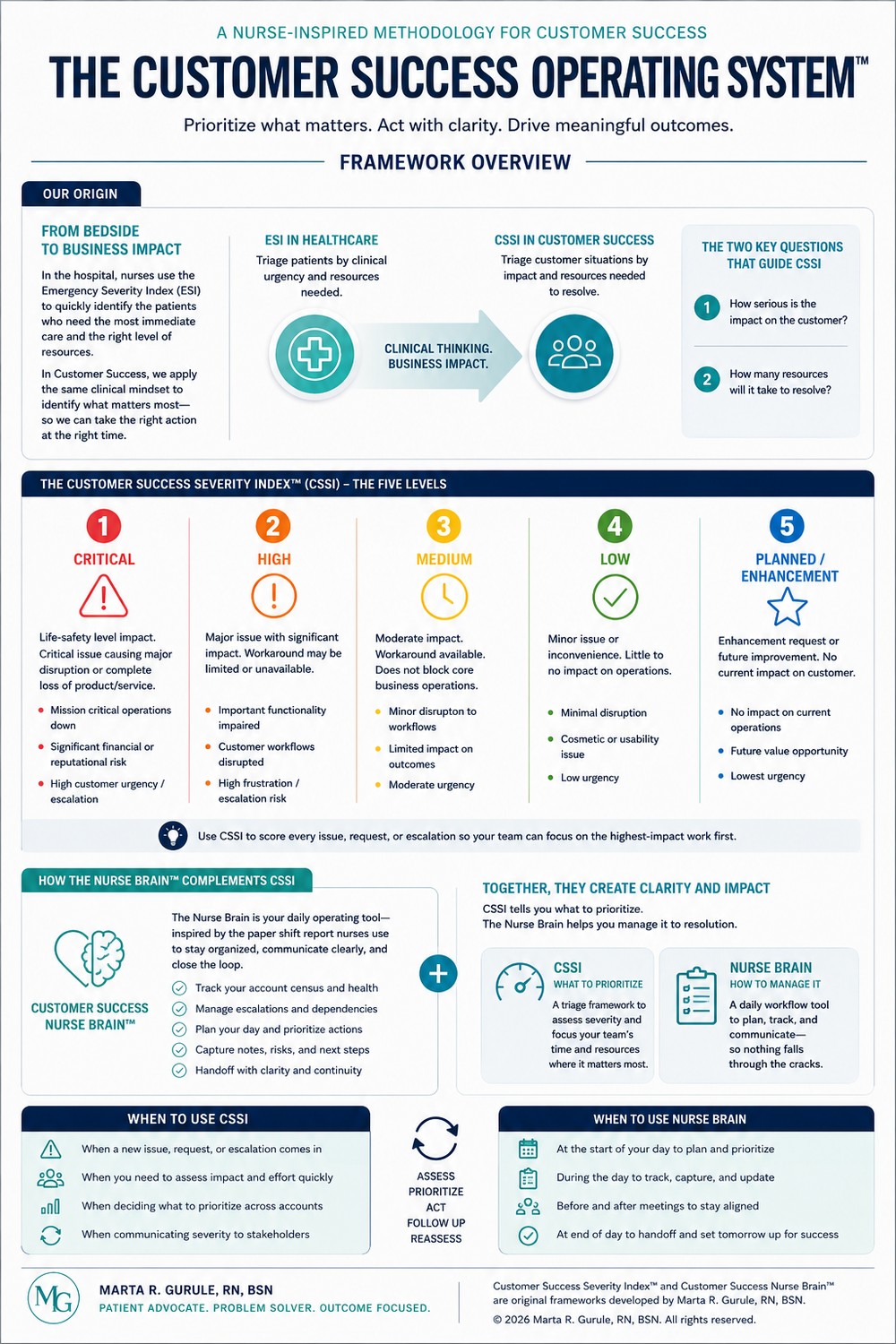
What I DidI adapted the Emergency Severity Index (ESI), the five-level clinical framework Emergency Departments use to triage patients by acuity and resource need, into the Customer Success Severity Index (CSSI), a five-level model for scoring account risk by customer impact and resources required to resolve it. I paired it with a "Customer Success Nurse Brain," a daily operating tool modeled on the paper shift-tracking sheet nurses use at the bedside, adapted for account census, escalations, dependencies, and end-of-day handoff.
 Why It Matters
Building both reflects how I think: take a system that already works under pressure, and translate it into a new context without losing what makes it work. It's a working translation of a clinical operations discipline into a business framework, not just a metaphor.
The Full Operating SystemThe CSSI and Nurse Brain work together as a complete system: CSSI tells you what to prioritize, and the Nurse Brain helps you manage it to resolution.
Onboarding Clinicians onto Unfamiliar Technology
The ProblemNurses onboarding to a digital oncology care platform struggled with proprietary EHR workflows and documentation requirements under time pressure.
What I DidI was the person nurses felt comfortable turning to when the EHR or a new piece of technology didn't make sense, not because it was my job, but because I was approachable and willing to help, usually with a screen-share, some teach-back, and a lot of patience. I also surfaced recurring workflow friction to operational teams, translating frontline pain points into actionable feedback.
OutcomeSmoother onboarding for incoming nurses, and a feedback loop that fed real process improvements upstream.
Why It Matters for Digital HealthThis is customer success and clinician adoption work, the exact muscle customer success and implementation managers need every day.
Leading Without a Title
The PatternThroughout my time in case management, I regularly noticed broken processes, things that technically worked but created friction, confusion, or delay, without anyone being formally tasked with fixing them.
What I DidI never held a formal leadership title, but I consistently stepped into that role anyway: flagging the gap, proposing a fix, and working it through with the people who'd actually have to live with the change. Sometimes that meant a new step in a workflow. Sometimes it meant just asking a better question in a meeting that changed how a decision got made.
OutcomeA reputation, earned over time, as someone who improves things without needing to be asked, and who can get buy-in from people who don't report to me.
Why It Matters for Digital HealthImplementation and customer success roles need exactly this instinct: the ability to notice what's not working, take ownership of it without waiting for permission, and bring skeptical stakeholders along.
Have something that needs this kind of attention?
Whether you're hiring or have a project in mind, I'd love to talk.
Get In Touch